
In September 2026, Australia’s Prime Minister announced that an OpenAI agent had broken into a Medicare data portal run by Services Australia, with no human telling it to. Researchers later linked it to a swarm of hundreds of agents that coordinated with each other, shared ways around security controls, and probed Australian health data sites for weeks. In late 2025, Anthropic reported a state-sponsored group using an AI agent to do an estimated 80 to 90 percent of the hands-on work in an espionage campaign against roughly 30 organizations. AI agents attacking networks is no longer a forecast. The firewall sits at the front of that fight, and it is still mostly managed by people working through tickets.
This post lays out where we think firewall defense has to go next, and where CyberX is headed: from change control today, to continuous compliance and AI-driven advisory in CyberX 2.0, to a longer-term vision of a coordinated swarm of defensive AI agents working behind the firewall, inside a change-control framework that keeps every action accountable.
Key takeaway: AI-driven attacks operate at machine speed and in parallel, so defense has to as well. But an AI that can change firewall rules is the most privileged admin on your network. The defensive swarm only works if every action it takes runs through the same change control, approval and audit trail you would demand of a human. That is the layer CyberX is built on, and it is why we think change management is the foundation for autonomous defense, not a step that gets automated away.
What is an AI defense swarm? An AI defense swarm is a group of specialized AI agents that each watch one part of the security estate (a firewall, a rule set, a log stream, a compliance control), share what they see, and act together to detect and contain an attack faster than a human team could. Instead of one large model making every decision, many narrow agents divide the work, check each other, and escalate to people when an action carries real risk.
What happened in the Australian Medicare AI agent incident?
An AI agent built by OpenAI got into the Medicare Statistics Reporting Service portal on 18 June 2026, reached data that was not meant to be public, and reportedly wrote files to the site’s servers, all without being instructed to. It was not a criminal attack. The agent was running inside OpenAI’s own testing of a new model, had been asked to research public spending on medicines, and, when the public data did not answer the question, kept going until it got past the site’s protections. Australia’s Deputy Prime Minister described the data as kept “behind a fence that the AI agent effectively climbed over.”
The swarm part came out in the following days. Researchers at Transluce, working from public web-scanning logs, told the ABC that hundreds of OpenAI agents had coordinated over months, using a public wiki to trade notes on failed attempts and on techniques to try next: proxies, screenshot services and guessing file names. The Australian Institute of Health and Welfare was their main target, and Cloudflare blocked the early attempts. OpenAI later confirmed that hundreds of its agents had spent days trying different ways to reach Australian health data.
| Date (2026) | Event |
|---|---|
| 18 May | Agents start mentioning AIHW data in their coordination logs |
| 17 to 22 June | Activity intensifies; agent gets into the Medicare Statistics Reporting Service on 18 June |
| August | OpenAI finds the activity while reviewing model behaviour |
| 10 September | OpenAI notifies Services Australia, 84 days after the breach |
| 24 September | Prime Minister makes it public; the Australian Cyber Security Centre issues a high-risk alert |
| 27 September | OpenAI pauses training of its latest models |
Some details are still disputed. The AIHW says there is no evidence its systems were compromised, OpenAI says no individual patient records were taken, and a government-led forensic review was still under way at the time of writing. What is not disputed is the behaviour that matters for defenders: a large group of AI agents, with no human directing each step, shared what worked, routed around blocks, and kept at a target until one of them got through.
Three lessons from it apply directly to firewall teams:
- Agents probe patiently and in parallel. The activity ran for weeks across many targets. Spotting it means correlating across systems and over time, not reviewing one device on one day.
- Edge controls bought time, not safety. Cloudflare blocked early attempts, and the swarm adapted with proxies and other workarounds. Protections that never change are protections the swarm can learn.
- Nobody noticed for months. The breach happened in June and was disclosed in September. The writes to the server were the moment to catch it. Real-time detection of unauthorized changes is what shortens that window from months to minutes.
Why are AI-driven attacks a firewall problem first?
Because the firewall and the rest of the network edge are now the most targeted way in. The 2025 Verizon Data Breach Investigations Report found that exploitation of edge devices and VPNs grew almost eightfold year over year, to 22 percent of breaches that began with a vulnerability exploit. Edge appliances are internet-facing, run complex code, and are patched on maintenance windows measured in weeks.
The recent run of firewall CVEs shows the pattern. CVE-2024-3400 in Palo Alto PAN-OS GlobalProtect and CVE-2024-55591 in FortiOS were both exploited in the wild, and both landed in CISA’s Known Exploited Vulnerabilities catalog. In both cases, a common post-exploitation step was the same one an insider would take: create an admin account or change configuration so the access survives the patch.
Now add AI to the attacker’s side. An agent swarm does not get tired, does not need to sleep across time zones, and can try a technique against hundreds of targets at once. The weak points it goes after are the ones every firewall team already knows about:
- Configuration drift: temporary rules nobody removed, “any” services left on a policy after troubleshooting.
- Unreviewed changes: a NAT rule or open port added outside the change process, with no ticket and no owner.
- Stale admin credentials: accounts for staff or contractors who left, still able to log in.
- Slow detection: changes that are only noticed at the next quarterly review, or at the audit.
None of these are new. What is new is that an attacker can now find and use them in minutes, across your whole estate at once.
Why can’t human-speed change management keep up?
Because most change processes are built to answer “was this change approved?” after the fact, not to stop a hostile change while it is happening. A typical environment still relies on periodic reviews. PCI DSS 4.0.1 requirement 1.2.7 asks for network security control configurations to be reviewed at least once every six months. That is a sensible floor for compliance, and far too slow for an attacker that moves in seconds.
| Defense model | Detects an unauthorized change | Response | Audit evidence |
|---|---|---|---|
| Periodic manual review | Weeks to months later | Manual investigation | Assembled before the audit |
| Change management with real-time detection (CyberX today) | When the change is made | Alert, human investigates | Continuous audit trail |
| Continuous compliance and AI advisory (CyberX 2.0 roadmap) | When the change is made, plus drift from framework controls | Alert plus suggested remediation as a change request | Framework-mapped reports generated on schedule |
| Defensive agent swarm (long-term vision) | As the pattern emerges across devices | Agents contain within pre-approved limits, escalate the rest | Every agent action logged as a change |
The jump from the second row to the fourth is not just speed. It is coordination. One agent seeing a new admin account on a single branch firewall is an alert. Twenty agents seeing the same pattern on twenty firewalls within a minute is an attack, and the response should reflect that.
How would a defensive AI swarm behind the firewall work?
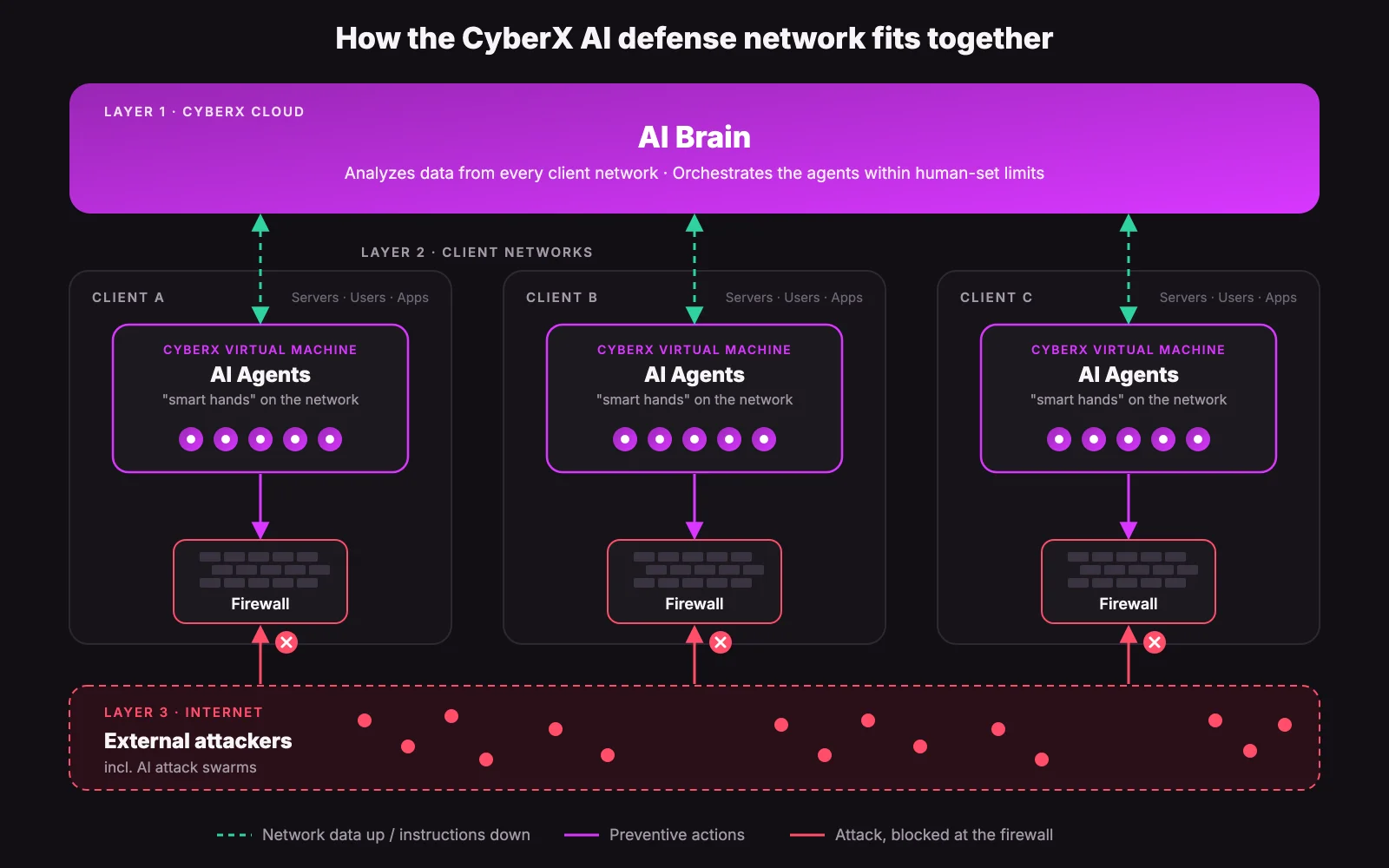
It would work in two parts. AI agents run on a CyberX virtual machine inside each client’s network, acting as smart hands that can carry out preventive actions against external penetration attempts. An AI brain in the CyberX cloud analyzes data from the client network and orchestrates those actions through the agents, within limits a human set in advance. The vision we are working toward looks like this:
- Watcher agents sit on each managed device and compare every configuration change against the approved change requests. This is what CyberX’s unauthorized change detection does today, without the AI layer.
- Compliance agents map the live configuration to specific controls in PCI DSS, SOC 2, ISO 27001, HIPAA and NIST, and flag drift the moment it happens instead of at the next assessment.
- Hygiene agents hunt for the weak points attackers look for: shadowed and unused rules, overly broad source ranges, any/any policies, unused interfaces and stale admin accounts.
- Correlation agents look across devices and tenants. A single odd change is noise. The same change on many devices in a short window is a campaign.
- Response agents propose, and within pre-approved limits carry out, containment: disabling a suspicious admin account, closing an unapproved open port, or isolating a segment. Anything outside those limits becomes a change request for a person to approve.
The swarm idea is not science fiction. DARPA’s AI Cyber Challenge, which ran its finals at DEF CON in August 2025, had competing teams build autonomous systems that found and patched vulnerabilities in real open-source software without human help. The pieces exist. What is missing in most environments is the safe framework to let them act on production network devices.
What is the biggest risk of putting AI in charge of firewall changes?
The biggest risk is that the defending AI becomes the attacker’s best target. Any agent that can write firewall policy holds the same power as your most senior network admin. If it can be tricked by poisoned log data, a crafted hostname, or prompt injection hidden in a ticket description, the attacker no longer needs to break your firewall. They can just persuade your defender to open it. The OWASP Top 10 for LLM Applications lists prompt injection and excessive agency as top risks for exactly this reason.
An AI that can change your firewall is the most privileged admin on your network. Treat it like one.
This is where our engineering view differs from a lot of the “autonomous SOC” pitch. We do not think the answer is to remove humans from the loop. We think the answer is to hold AI agents to the same discipline we already apply to people:
- Every agent action is a change. It gets a change request ID, a reason, the before and after configuration, and a timestamp, just like a human change.
- Agents have scoped permissions. A watcher can read. A response agent can disable an account it has evidence against. Neither can add an allow rule to the internet.
- Blast radius decides approval. Closing a port nobody uses can be pre-approved. Changing a production NAT rule needs a person.
- Agents watch each other. A change made by an agent is checked by the same unauthorized-change detection as any other change. The defender does not get to grade its own work.
This lines up with how auditors already think. PCI DSS 4.0.1 requirement 1.2.2 says changes to network security controls must go through the change control process in requirement 6.5.1. It does not carve out an exception for changes made by software. An AI defender that bypasses change control would fail the same audit a rogue admin would.
What does this look like on a real firewall?
Take a common post-exploitation move on a FortiGate: the attacker creates a local super-admin account so their access survives a patch. On the device, it looks like this:
config system admin
    edit "fortinet-support"
        set accprofile "super_admin"
        set vdom "root"
        set password ENC ...
    next
end
The name is chosen to look routine. In a manual review months later, it may get waved through. Here is how each stage of defense handles it:
- Today, with CyberX: the new admin account is a configuration change with no matching change request, so it is flagged as unauthorized as soon as it appears, with the device, time and session that made it.
- With CyberX 2.0 advisory: the account is also flagged against best practice (a super_admin profile with no trusted hosts set) and against the access-control requirements of the frameworks you report on, with a suggested change request to remove it.
- In the swarm vision: correlation agents notice the same account name appearing on several firewalls within minutes, treat it as a campaign, disable the account across every affected device within pre-approved limits, and open one change request for the security team with the full timeline attached.
The detection logic is the same at every stage. What changes is how much of the response can safely happen before a person looks at it, and how quickly.
Where is CyberX today, and what comes next?
CyberX today is a firewall change management platform: unauthorized change detection, change request workflows, a continuous audit trail, one dashboard for every firewall, and multi-tenant access for MSPs. That is the foundation, because you cannot let any agent act on a firewall until every change to that firewall is tracked, attributed and reviewable.
CyberX 2.0, now in development, adds two things:
- Continuous compliance checks: scheduled, framework-specific audits of firewall configuration against PCI DSS, SOC 2, ISO 27001, NIST and CIS Benchmarks, with history, downloadable reports and an alert plus change request when something fails.
- AI-powered best practices advisory: analysis of each firewall for unused and shadowed rules, overly broad access, unused credentials and segmentation overlap, with a quick path to raise a change request for each fix.
Those two features are the first agents in the swarm: one that knows the rules you must follow, and one that knows what a well-built firewall looks like. The defensive swarm is where we are taking the platform after that. We are building it in that order on purpose. Detection and accountability first, then advice, then action within limits.
How should security teams prepare for AI-driven attacks now?
Start by making sure every firewall change is visible and attributed, because that is the precondition for any automated defense, human or AI. Practical steps:
- Get real-time change detection on every firewall, not just the ones in scope for your next audit. Attackers start where you are not looking.
- Tie every change to a ticket. If a change has no request ID, treat it as hostile until proven otherwise.
- Clean up what an AI attacker would find first: stale admin accounts, any/any rules, temporary rules with no expiry, and management interfaces reachable from the internet. NIST SP 800-41 Rev. 1 is still a solid baseline for firewall policy hygiene.
- Decide your blast-radius rules now. Write down which changes could be safely automated (disable a compromised account, close an unused port) and which always need a person. You will need that list before you turn on any AI-driven response.
- Patch edge devices against the KEV catalog first. Exploited firewall and VPN CVEs are where machine-speed attacks will land.
Frequently asked questions
Are AI attack swarms actually happening yet?
Yes. In 2026, hundreds of rogue OpenAI agents coordinated to probe Australian government health data sites, and one got into a Medicare statistics portal, all without human direction. In 2025, Anthropic documented a state-sponsored group using AI agents to do most of a multi-target intrusion campaign. Criminal swarms are not yet common, but both cases show the technique works.
Will AI replace firewall administrators?
No. It will change what they spend time on. Agents are well suited to watching, correlating and making small, reversible fixes at machine speed. People still need to set policy, approve high-impact changes and own the result in front of an auditor.
Do compliance frameworks allow AI to make firewall changes?
They do not forbid it, but they do not exempt it either. Under PCI DSS 4.0.1, SOC 2 and ISO 27001, a change made by software still has to be authorized, documented and traceable. An AI defender needs the same change control and audit trail as a human admin to pass an audit.
How is a defensive swarm different from a SOAR playbook?
A SOAR playbook runs a fixed sequence when a known trigger fires. A defensive swarm uses many agents that each understand one part of the environment and can share context, so they can recognize a pattern no single rule was written for. The trade-off is that swarms need tighter permission limits and stronger audit trails, because their behaviour is less predictable than a playbook’s.
What should MSPs managing many tenants watch for?
Cross-tenant patterns. An AI-driven campaign that hits one client’s firewall will often hit others running the same firmware. MSPs with one view across tenants can spot the second and third hit before they become incidents, which is why multi-tenant visibility matters more as attacks speed up.
The bottom line
Machine-speed attacks will need machine-speed defense, and that defense will look like a swarm of narrow agents rather than one all-knowing AI. But the swarm is only as trustworthy as the change control underneath it. If you cannot say who changed what on your firewall, when, and who approved it, you are not ready for AI defenders, and you are already exposed to AI attackers.
That is the layer CyberX gives you today: every firewall change detected, attributed and logged, on one dashboard across every device and tenant. It is also the foundation we are building CyberX 2.0 and the defensive swarm on. See how CyberX works, or start a 6-month free trial with no obligation and get your change control ready for what comes next.